

We often get asked 'what is a domain?' and for good reason. There are a lot of misconceptions when it comes to what a domain actually is, so let's take a look.
What is a domain?
In very simple terms, a domain can be thought of as the address of a website. You type it into a search bar and are taken to the website.
For instance, our domain is 'prystine.co.uk' and if you type that into your search bar you will be directed to our website - please do feel free to give it go!
The technical explanation...
A domain stores information (records) about where your website and other web services are located - essentially where they are hosted.
The location information is usually in the form of IP addresses of web servers.
So instead of typing in an IP address (which would be a string of numbers e.g. 202.12.64.20) to find a website, a domain means you just have to type in a word or two followed by its extension (e.g. prystine.co.uk). Isn't that just so much easier to remember?
What they are not
Let's de-myth the most common misconceptions and set the record straight:
- Domains are not websites.
- Domains are not website hosting.
- Domains are not URLs - more on this below.
All they do is just hold information on how to get to a website or web service (e.g. emails).
Seeing a domain in action
Figure #1 below allows you to see how domains work in a real life example. It breaks down a URL (Uniform Resource Locator) - the whole website address - and highlights key areas.
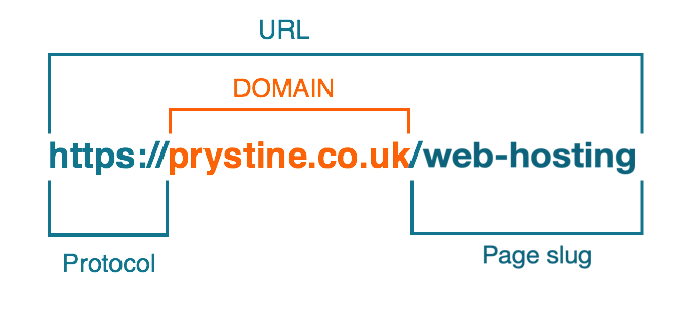
Brief explanations of the terms above:
- Protocol is the function used to fetch the website data. Commonly http:// or https://.
- Domain: as above.
- page slug is the unique identifier of your webpage.
- URL is essentially the whole website address. It's made up of the above three bullets.
Why you need a domain
You'll need one if you want to have a website because it will store all the information on how your visitors will find your website.